I'd like to share the result of a personal effort to revive MIT's historical Xok/ExOS exokernel research system.
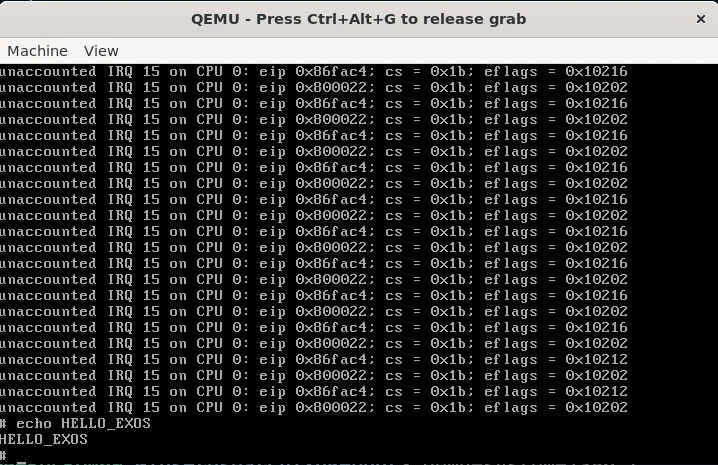
On November 13, 2026, I successfully booted Xok/ExOS in a modern QEMU i386 environment, reached the native login prompt, logged in, and executed a command in an interactive ExOS shell:
The original Exokernel research dates back to the 1990s, and the source distribution used in this project contains historical code from that period and around 2000.
Some of the main challenges included:
- Restoring Tulip PCI networking by addressing PCI bus-mastering initialization.
- Getting the NFS root filesystem working.
- Rebuilding ExOS user-space utilities with a historical GCC 2.7.2.3 cross-compiler.
- Fixing static library linking with explicitly forwarded linker group options.
- Restoring the console, login process, and interactive shell.
The project is not a complete restoration. There are still known issues, particularly repeated unaccounted IRQ 15 messages, incomplete user-space compatibility, and some historical configuration dependencies.
However, the main goal of reaching an interactive ExOS shell has been achieved.
I've published Xok/ExOS Revival v0.1.0, including a boot image, documentation in English, Simplified Chinese, and Traditional Chinese, and screenshots of the working system.
GitHub repository:
https://github.com/Evan-Windproof/xok-exos-revival
Release:
https://github.com/Evan-Windproof/xok-e ... tag/v0.1.0
This is an independent historical preservation and compatibility project, not an official MIT release. Full credit for the original Xok/ExOS architecture and implementation belongs to its original researchers and contributors.
I consider the main revival milestone complete, and I'm sharing the results for anyone interested in exokernels, historical operating systems, or low-level OS research.
Thanks for reading!