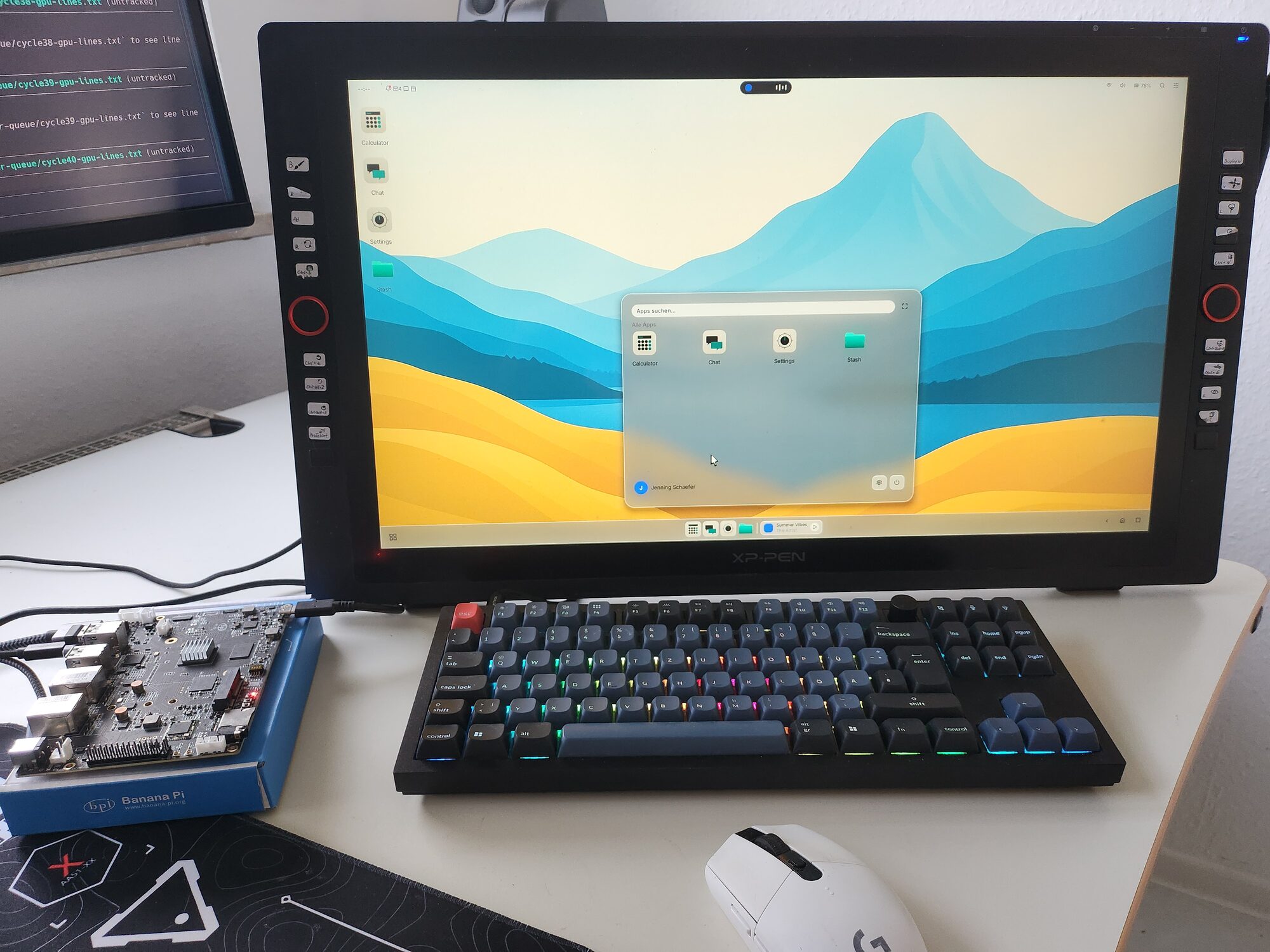
Real hardware
My main goal after my UI was getting off QEMU. I picked a Banana Pi BPI-F3 with the SpacemiT K1, since I'm still Risc-V only, and open nexus OS now boots from its eMMC, drives HDMI, takes a USB keyboard and mouse and composites the desktop on the GPU with my own driver. That's for normal desktop use, not 3D or gaming obviously.
For quite a while my only output was only the status LED. The kernel blinked its boot milestones, and I counted. Anything longer went into a log on the eMMC, which I read back afterwards from the vendor Linux on the SD card.
How I tried to make drivers faster
Shortly before the board arrived I had read about Alyssa Rosenzweig and her work on the Asahi GPU driver. I tried to turn her approach into a repeatable method. First I measure on the vendor OS, read-only. From those measurements I define gates, which are boot markers that decide pass or fail. Then I write tests from the gates against a small host-side model, write the code against the tests, and only then go to the board. That pretty much eliminates guessing. After debugging, the gates get sharpened or dropped.
Everything is committed: the measurement scripts, the dumps and a note for every board cycle. My hope is that the next driver only needs the deltas to adjust.
The full story, with examples and the paths in the code, is in the blog post:
https://open-nexus-os.io/blog/the-docum ... ish-i-had/
About AI
I know this topic still splits people, and I probably won't make anyone happy with my answer. I don't have a community, so AI is a big part of how I work. In practice that means help with the time-consuming parts: writing measurement scripts, going through register dumps and boot logs, running tests and writing code against them.
But the system is very far away from automation. As people here probably know best, a driver is more than a sequence of hardware commands. Someone still has to understand what it does and why, and decide which implementation fits the architecture and where the system is going. So, you still won't get production ready drivers in a few days with a few prompts.
Questions and criticism of the method are welcome. But I am very happy to see my OS on real now.