VibeBIOS - BIOS written by AI
Posted: Sat Jul 18, 2026 5:15 pm
Hi everyone! :3
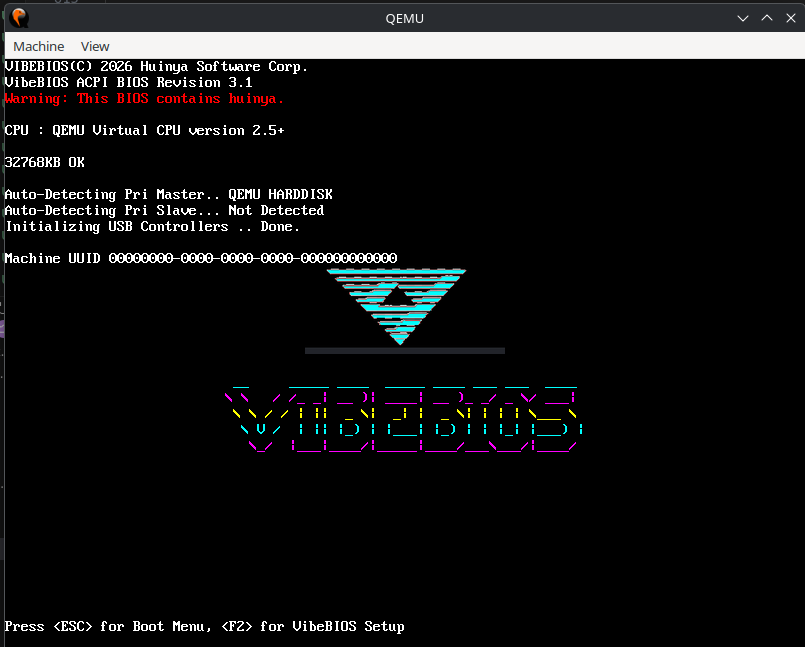
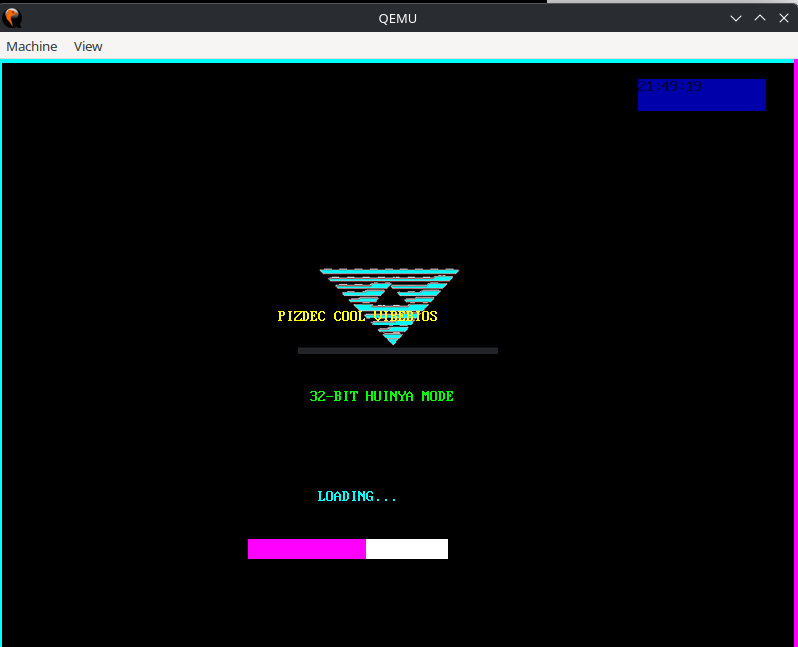
I’d like to share an interesting project I’ve been working on recently. It’s called VibeBIOS—an AI-generated, custom 32-bit graphical replacement for the classic BIOS (legacy BIOS), designed primarily for the QEMU and Bochs emulators.
Key Features & Highlights:
How to test it:
If you want to play around with it, the code is extremely easy to build. You just need `nasm` and `gcc`.
This will compile the bios.bin (which fits neatly into 128KB) and launch it in QEMU with a dummy os.bin payload.
Source Code:
You can find the full source code here: GitHub - VibeBIOS
I would love to hear your thoughts, feedback, or any architectural roasts! Has anyone else here tried building a fully graphical 32-bit setup utility for a legacy BIOS?
Cheers!
I’d like to share an interesting project I’ve been working on recently. It’s called VibeBIOS—an AI-generated, custom 32-bit graphical replacement for the classic BIOS (legacy BIOS), designed primarily for the QEMU and Bochs emulators.
Key Features & Highlights:
- 32-bit Protected Mode GUI: The moment the system boots, VibeBIOS jumps into 32-bit PM, initializes the Bochs/QEMU VBE to 800x600 (32-bpp), and draws a fully graphical Setup Utility and Boot Menu.
- POST Animation & Music: Instead of a boring black screen, the POST screen features a real-time rendering of a fade-in logo (or a rotating 3D wireframe cube) while simultaneously playing a custom POST melody through the PC Speaker via port 0x61.
- PS/2 Mouse Support in BIOS: The Setup Utility isn't just keyboard-driven. I implemented a PS/2 mouse driver with a custom drawn cursor, so you can actually click through the BIOS tabs!
- CMOS NVRAM Storage: Settings (like active font, IDE/ACPI toggles) are written to and read from the standard RTC CMOS registers (0x30-0x32), surviving soft resets.
- Hardware Init: Basic PCI enumeration (displays a hardware tree in the Advanced tab), ATA PIO disk detection, and Floppy detection. It also generates basic SMBIOS and ACPI (RSDP/RSDT) structures.
- The "Drop-Back" Boot Mechanism: To actually boot a legacy OS, VibeBIOS loads the boot sector (HDD, FDD, or PXE), extracts and executes the VGA Option ROM, constructs a dummy 16-bit IVT, and successfully transitions back from 32-bit Protected Mode to 16-bit Real Mode to execute a far jump to 0x7C00.
How to test it:
If you want to play around with it, the code is extremely easy to build. You just need `nasm` and `gcc`.
Code: Select all
make clean && make run
Source Code:
You can find the full source code here: GitHub - VibeBIOS
I would love to hear your thoughts, feedback, or any architectural roasts! Has anyone else here tried building a fully graphical 32-bit setup utility for a legacy BIOS?
Cheers!